More Open Chords
C, D, G, A, and E — the essential five
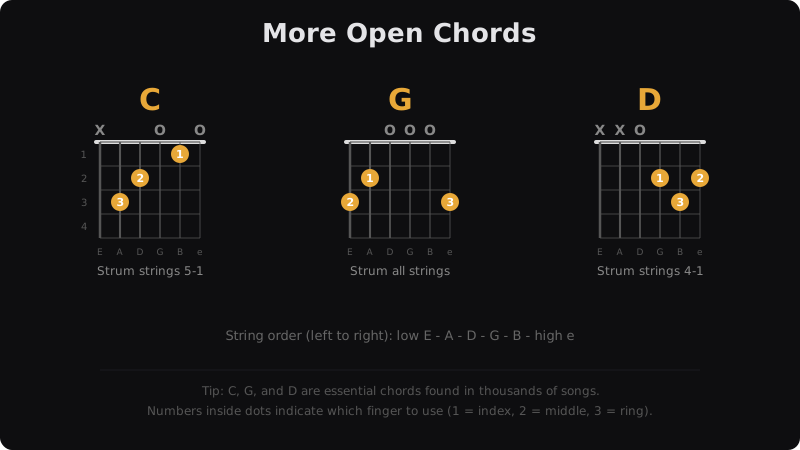
The Open Chord Family
With Em and Am under your belt, it's time to learn the five most important open chords in guitar. These chords, combined with Em and Am, let you play a huge number of songs. "Open" means they use at least one open (unfretted) string.
Take your time with each one — accuracy matters far more than speed at this stage.
C Major
Index finger: fret 1, string 2 (B)
Middle finger: fret 2, string 4 (D)
Ring finger: fret 3, string 5 (A)
Strum from string 5 down. Don't hit string 6.
C major is one of the most common chords in all of music. The stretch between your ring finger on fret 3 and index on fret 1 can feel awkward at first — this is normal and gets easier quickly.
D Major
Index finger: fret 2, string 3 (G)
Ring finger: fret 3, string 2 (B)
Middle finger: fret 2, string 1 (high E)
Strum from string 4 down. Don't hit strings 5 or 6.
D major has a bright, happy sound. It's a compact shape — all three fingers are close together on frets 2 and 3. Make sure your ring finger on string 2 isn't muting string 1.
G Major
Middle finger: fret 3, string 6 (low E)
Index finger: fret 2, string 5 (A)
Ring finger: fret 3, string 1 (high E)
Strum all 6 strings.
G major is a big, full chord. The stretch between string 6 and string 1 feels wide at first. Some people use their pinky on string 1, fret 3 instead of the ring finger — either works.
A Major
Index finger: fret 2, string 4 (D)
Middle finger: fret 2, string 3 (G)
Ring finger: fret 2, string 2 (B)
Strum from string 5 down. Don't hit string 6.
All three fingers are on fret 2, which makes this a compact, comfortable shape. The challenge is fitting three fingers into one fret without muting adjacent strings. Make sure your fingers are well-curved.
E Major
Index finger: fret 1, string 3 (G)
Middle finger: fret 2, string 5 (A)
Ring finger: fret 2, string 4 (D)
Strum all 6 strings.
Notice this is the same shape as Am, just shifted down one string. E major is full and resonant, using all six strings. It's also the foundation of many barre chord shapes you'll learn later.
Tab Examples
C Major chord
e--0-- B--1-- G--0-- D--2-- A--3-- E-----
D Major chord
e--2-- B--3-- G--2-- D--0-- A----- E-----
G Major chord
e--3-- B--0-- G--0-- D--0-- A--2-- E--3--
A Major chord
e--0-- B--2-- G--2-- D--2-- A--0-- E-----
E Major chord
e--0-- B--0-- G--1-- D--2-- A--2-- E--0--
Chord Diagrams
Tips
- Learn one new chord per day rather than all five in one sitting
- Always check each string individually when forming a new chord
- C and G are often paired together — practise switching between them
- A and D are natural partners too — many songs use A-D-A-D
- Don't be discouraged if your fingers feel clumsy — everyone goes through this
Practice Exercises
- Learn each chord shape and check all strings ring cleanly
- Practice switching: G→C, C→Am, D→A, Em→G — 4 strums each, metronome at 50 BPM
- The "one minute change" drill: set a timer, switch between two chords as many times as you can in one minute. Track your count daily.
- Try the progression G - D - Em - C (4 strums each) — this is used in hundreds of pop songs