Tuning Your Guitar
If it's not in tune, nothing else matters
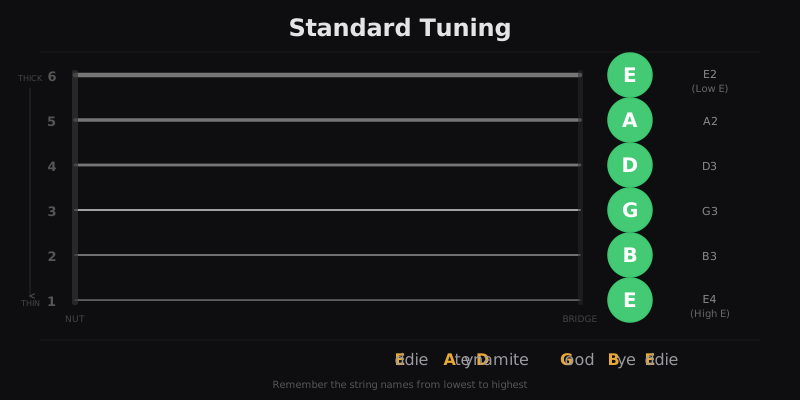
Standard Tuning
Standard tuning from string 6 (thickest) to string 1 (thinnest) is:
E — A — D — G — B — E
This is the tuning that 95% of guitar music assumes. Every lesson in this course uses standard tuning unless stated otherwise. Always tune before you play — temperature, humidity, and simply playing the guitar will cause it to drift out of tune.
Using a Digital Tuner
The easiest and most reliable method. Clip-on tuners attach to your headstock and detect pitch through vibration. Phone apps work too but are less accurate in noisy environments.
Pluck a string and the tuner will show you what note it's closest to and whether you're sharp (too high) or flat (too low). Turn the corresponding tuning peg:
- Too low (flat): tighten the string (turn the peg so the string gets tighter)
- Too high (sharp): loosen slightly, then tune back up
Always tune up to the note, not down. If you overshoot, loosen the string below the target note and tune up again. This keeps tension consistent and helps the string stay in tune longer.
Relative Tuning (No Tuner)
If you don't have a tuner, you can tune the guitar to itself. This won't be at concert pitch, but all strings will be in tune with each other:
1. Assume string 6 (low E) is correct (or tune it to a reference)
2. Press string 6 at fret 5 — this should sound the same as open string 5 (A)
3. Press string 5 at fret 5 — matches open string 4 (D)
4. Press string 4 at fret 5 — matches open string 3 (G)
5. Press string 3 at fret 4 — matches open string 2 (B) ← note: fret 4, not 5!
6. Press string 2 at fret 5 — matches open string 1 (high E)
The odd one out is strings 3→2 which uses fret 4. This is because of how guitar tuning intervals work (the B string breaks the pattern of fourths).
Tuning Tips
New strings stretch and go out of tune frequently — this is normal. After putting on new strings, stretch them gently by pulling them away from the fretboard, retune, and repeat a few times.
If a string won't hold tune at all, it may be worn out, improperly wound around the tuning peg, or the tuning peg mechanism itself may be loose.
Get into the habit of checking tuning every time you pick up the guitar and between songs. It takes 30 seconds and makes everything sound dramatically better.
Tab Examples
Relative tuning reference frets
e---------------------0--- B---------------0--5----- G-----------0--4--------- D-------0--5------------- A---0--5----------------- E--5---------------------
Tips
- Always tune up to the note, not down — this prevents slipping
- The 5th fret trick works for all strings except 3→2 (use fret 4)
- Tune every time you play, even if you only played yesterday
- Free tuner apps work fine for beginners — GuitarTuna, Fender Tune, etc.
Practice Exercises
- Tune your guitar using a tuner or app right now
- Try relative tuning: tune string 5 using fret 5 of string 6, then continue up
- Deliberately detune one string slightly, then tune it back — train your ear