Holding the Guitar & Posture
Setting up for comfort and control
Why Posture Matters
Bad habits formed in the first week can take months to undo. Getting your posture right from the start means less pain, less fatigue, faster fingers, and better sound. Every professional guitarist will tell you the same thing: how you hold the guitar matters enormously.
Sitting Position
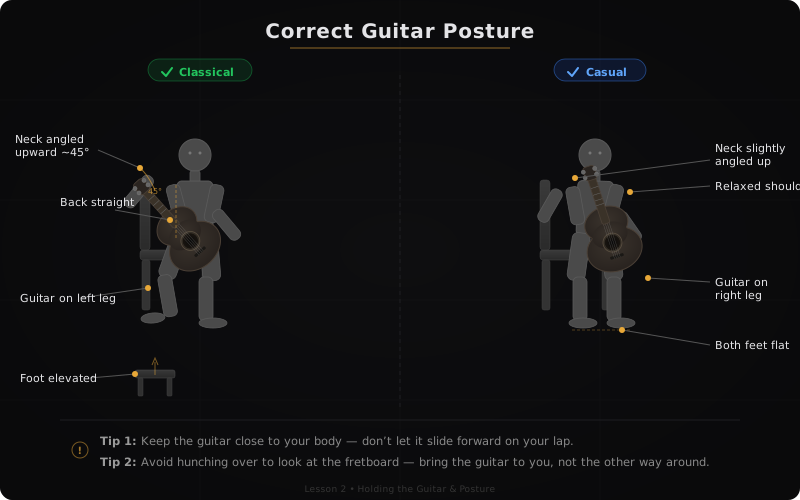
Sit on a chair or stool without arms. You want your feet flat on the floor, back reasonably straight. The guitar body rests on your right thigh (for right-handed players) with the waist of the guitar (the curved indent) sitting naturally on your leg.
The neck should angle slightly upward — roughly 30-45 degrees from horizontal. If the neck points straight ahead or downward, your fretting hand has to work much harder. A small upward angle opens everything up.
Don't hunch over to look at the fretboard. It's tempting, but it creates tension across your shoulders and back. You'll learn to feel the frets without looking constantly.
Classical position (optional): rest the guitar on your left thigh with your left foot elevated on a footstool. This gives an even better neck angle and is used by classical and many fingerstyle players.
Standing Position
With a strap, adjust the length so the guitar sits at roughly the same position as when you're sitting. Many beginners sling it too low because it looks cooler — but playing with the guitar at hip level or below forces your wrist into strained angles.
A good check: can you comfortably reach fret 1 without stretching? Can your picking hand reach all the strings without hunching? If yes, the height is right.
Fretting Hand Position
Your fretting hand (left hand for right-handed players) wraps around the neck with the thumb behind the neck, roughly opposite your middle finger. The thumb acts as an anchor and counter-pressure point.
Your fingers should curve and come down on the strings with the tips of your fingers, not the flat pads. Curving your fingers means each finger only touches the string it's fretting and doesn't accidentally mute adjacent strings.
Keep your wrist relatively straight — not bent at a sharp angle. A slight curve is natural, but excessive bending causes strain and limits finger reach.
Picking Hand & Pick Grip
Hold the pick between your thumb and index finger. The pick rests on the side of your index finger, and your thumb presses down on top. Only a small triangle of the pick should poke out — a few millimetres is enough.
Grip firmly enough that the pick doesn't fly away, but not so tight that your hand tenses up. Think of holding a small coin — secure but relaxed.
Rest your picking hand lightly near the bridge or let your forearm rest on the top edge of the guitar body. Your wrist does most of the picking motion, not your whole arm.
If you're fingerpicking, your thumb handles strings 6, 5, and 4. Your index finger takes string 3, middle finger takes string 2, and ring finger takes string 1. These are labelled p, i, m, a (from the Spanish: pulgar, indice, medio, anular).
Tips
- If your shoulder or wrist hurts after 10 minutes, something is wrong — adjust before continuing
- A mirror is helpful when starting out so you can check your posture
- Relax. Tension is the enemy of good guitar playing at every level
- Short nails on your fretting hand are essential — trim them as short as comfortable
Practice Exercises
- Sit with your guitar for 2 minutes without playing — just get the position comfortable
- Practice picking each open string cleanly: one slow downstroke per string, E to e and back
- Check your thumb position: is it behind the neck, roughly behind your middle finger?
- Try holding a pick and strumming all strings slowly — focus on grip, not sound